
Making Tax Digital for Income Tax: What It Actually Means for You
Glenn Bowen, Director, Grampian Accounting – September 2026
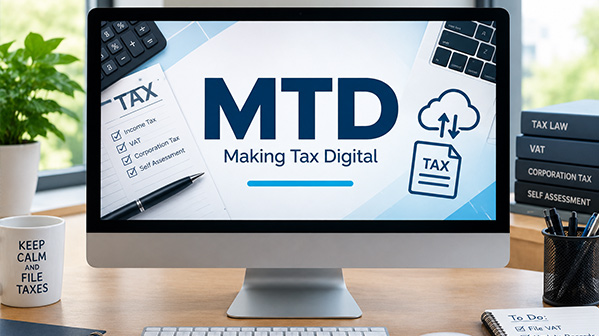
Making Tax Digital (MTD) is one of those phrases that’s been floating around for years, causing more worry than it needs to. So here’s a plain-English explanation of what it is, who it affects right now, and what it actually changes — which, for the moment, is less than most people fear.
The short version
MTD can refer to two taxes at the moment –
- MTD for VAT which has been in place for years – if you are VAT registered you should already be aware of this (or be receiving angry letters from HMRC to address it), if you are not registered this doesn’t affect you
- MTD for Income Tax and Self Assessment which is the new piece – this is the new piece we will discuss and layout here
If you’re a sole trader or landlord with qualifying income over £50,000, MTD for Income Tax applies to you now; the threshold falls to £30,000 in 2027 (based upon your 25/26 tax return info) and £20,000 in 2028. It doesn’t change how much tax you pay or when — it means four quarterly digital updates plus a year-end Final Declaration, kept in compatible software, instead of a single annual return. The main thing to get right is having your digital record-keeping set up properly and early.
Who’s affected, and when
MTD for Income Tax is being phased in by income level. The key figure is your “qualifying income” — your gross income (before expenses) from self-employment and/or property, added together. An important note – Partnership income, strangely, is not counted.
- From April 2026: if your qualifying income is over £50,000, you’re in the first phase now.
- From April 2027: the threshold drops to £30,000.
- From April 2028: it drops again to £20,000.
One thing that catches people out: it’s the combined figure that counts. If you turn over £35,000 from your trade and take £20,000 in rent, that’s £55,000 of qualifying income — so you’re in from April 2026, even though neither source on its own crosses £50,000. The threshold is judged on the figures from your Self Assessment return, so the return you’ve already filed decides when you’re brought in.
What actually changes — and what doesn’t
Here’s the reassuring part: MTD does not change how much tax you pay, or when you pay it. Your tax bill is calculated exactly as before, and the payment dates are unchanged. What changes is how, and how often, you report your figures to HMRC.
Instead of one annual submission by the 31 January deadline, you’ll now make submissions through the year:
- Four quarterly updates — a digital summary of your income and expenses for each three-month period. The first quarter ran from April to June 2026, with a filing deadline of 7 August 2026, and the pattern continues each quarter after that.
- One Final Declaration — this replaces the old annual tax return, tying everything together at the year end, still due by 31 January.
So it’s five touchpoints a year instead of one. Importantly, a quarterly update is not a mini tax return — it’s a straightforward digital summary of the figures for that quarter, not a full reckoning.
The real practical change: digital records
The part that affects day-to-day habits most is that record-keeping now has done regularly and the results submitted to HMRC in a digitally compatible format. Note this DOES NOT mean you need to start using digital software if you don’t want to, there is ‘bridging software’ we can use that take your books and submit them digitally.
It’s also worth knowing there’s a new penalty-points system for late submissions replacing the old flat fine — another reason to have the process running smoothly from the start rather than catching up under pressure. HMRC have stated very clearly that while they will send out penalty point letters in the first year there will be no fines associated for the first 12 months as businesses adapt to the changes.
Where this might be heading
One thing we’d flag — and we want to be clear this is our anticipation, not something HMRC has announced or confirmed. Once your records are being reported quarterly, it wouldn’t surprise us if HMRC eventually moves to collecting tax quarterly too. It would be the logical next step. There is no timetable for this, and it may not happen — but it’s the kind of thing worth being mentally prepared for.
And although paying tax more often sounds like a negative, it doesn’t have to be. The feedback we’ve actually had from clients is that more frequent, smaller reckonings make it easier to plan for — no more nasty surprise every January, no scramble to find a large lump sum once a year. This type of collection may also get rid of payments on account which can often be a nasty surprise to those not expecting them. Spreading the awareness of what you owe across the year tends to make it feel more manageable, not less.Not sure whether MTD for Income Tax applies to you, or when — or want your record-keeping set up so the whole thing runs quietly in the background? That’s exactly what we’re here for. Get in touch and we’ll make sure you’re ready well ahead of your start date, rather than finding out the hard way.